



India’s healthcare challenge is not just about numbers; it is about access. Over the years, the country has expanded medical education aggressively, increasing seats and producing more doctors than ever before. Official estimates today place India’s doctor – population ratio at around 1:800 when all recognised systems of medicine are included. On paper, this suggests progress. On the ground, the story is very different.
Doctors are unevenly distributed. Urban centres are saturated with specialists, while large parts of rural India still struggle with basic access to qualified medical care. This imbalance is the real crisis and it is precisely where artificial intelligence and healthtech startups are beginning to step in.
Globally, advanced healthcare systems operate at far higher physician densities. Many developed countries maintain more than three doctors per 1,000 people, supported by strong referral systems and digital infrastructure. India, by comparison, still relies heavily on overburdened primary centres, informal providers, and delayed referrals, especially outside cities. Increasing the number of doctors alone will not solve this. The system needs leverage.
This is where the idea of “AI doctors” enters the conversation not as replacements for human clinicians, but as force multipliers.
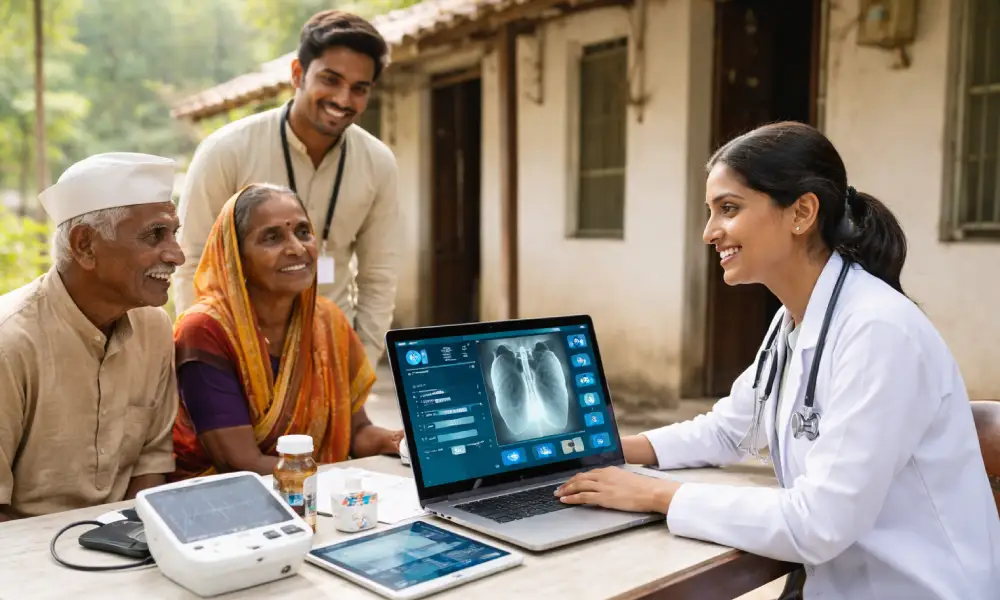
AI in healthcare is best understood as invisible support. It helps screen, prioritise, and guide care rather than delivering it independently. Algorithms now assist in reading X-rays, CT scans, ECGs, and pathology slides. Symptom-triage systems help decide who needs urgent attention and who can be managed locally. Remote monitoring tools allow specialists sitting in metros to support clinics hundreds of kilometres away.
For rural India, this shift is crucial. A single specialist, supported by AI-assisted diagnostics and telemedicine, can serve dozens of clinics instead of being limited to one hospital. That change alone alters the economics of care delivery.
Indian startups are already building around this reality. AI-powered diagnostic platforms are reducing the time taken to identify cardiac risks, tuberculosis, and early-stage cancers. Telemedicine platforms have normalised video consultations, digital prescriptions, and follow-up care even in Tier-2 and Tier-3 towns. Some companies are combining diagnostics, consultations, insurance, and medicine delivery into a single workflow, reducing friction and cost for patients.
Two operating models stand out as especially effective :
The first is AI-assisted task shifting. Frontline workers and primary health staff use digital tools to capture data scans, vitals, or symptoms which are then analysed by AI systems. Only high-risk cases are escalated to doctors. This saves time, reduces unnecessary referrals, and ensures serious cases are identified early.
The second is hub-and-spoke diagnostics. Small clinics act as data collection points, while AI engines and remote specialists operate from central hubs. Reports are generated faster, travel costs are avoided, and patients receive expert input without leaving their districts.
Cost reduction is not a side benefit; it is the core advantage. Healthcare in India is still largely paid out of pocket. AI-driven systems lower the cost per consultation, per diagnosis, and per follow-up by spreading specialist time across a larger population. When combined with public health programs or employer-backed coverage, these efficiencies can make quality care accessible to people who previously had no realistic options.
However, technology alone is not a silver bullet.
AI systems must be trained on Indian datasets, not imported assumptions. Devices must work in low-bandwidth, low-infrastructure environments. Regulatory clarity around accountability, data privacy, and clinical responsibility is essential. Most importantly, AI tools must be integrated into real clinical workflows. A flagged alert is useless if there is no doctor, ambulance, or referral pathway to act on it.
Policy support will determine how fast this transformation reaches scale. Public-private partnerships that deploy validated AI tools in government health centres can accelerate adoption. Investments in digital connectivity, standardised health records, and outcome-based funding models will matter more than flashy pilot projects.
There is also a human dimension that cannot be ignored. Nurses, paramedics, and community health workers are the backbone of rural care. AI, when designed well, empowers them rather than replacing them. Decision-support tools reduce burnout, improve confidence, and raise the quality of care delivered at the last mile.
The arrival of AI in Indian healthcare should not be framed as a futuristic disruption. It is a pragmatic response to a structural gap that has existed for decades. India may never have enough doctors evenly spread across geography but it can ensure that expertise travels faster than people.
If implemented responsibly, AI will not replace India’s doctors. It will make every doctor count more. And for millions in rural and underserved regions, that difference could mean earlier diagnosis, lower costs, and care that finally arrives on time.
Also Read : Tata 1mg’s Rise: How a Simple Idea Became India’s Trusted Digital Health Platform