



On Bengaluru’s chronically congested roads, a 27-year-old software engineer has turned his daily commute into an experiment in automated traffic enforcement.
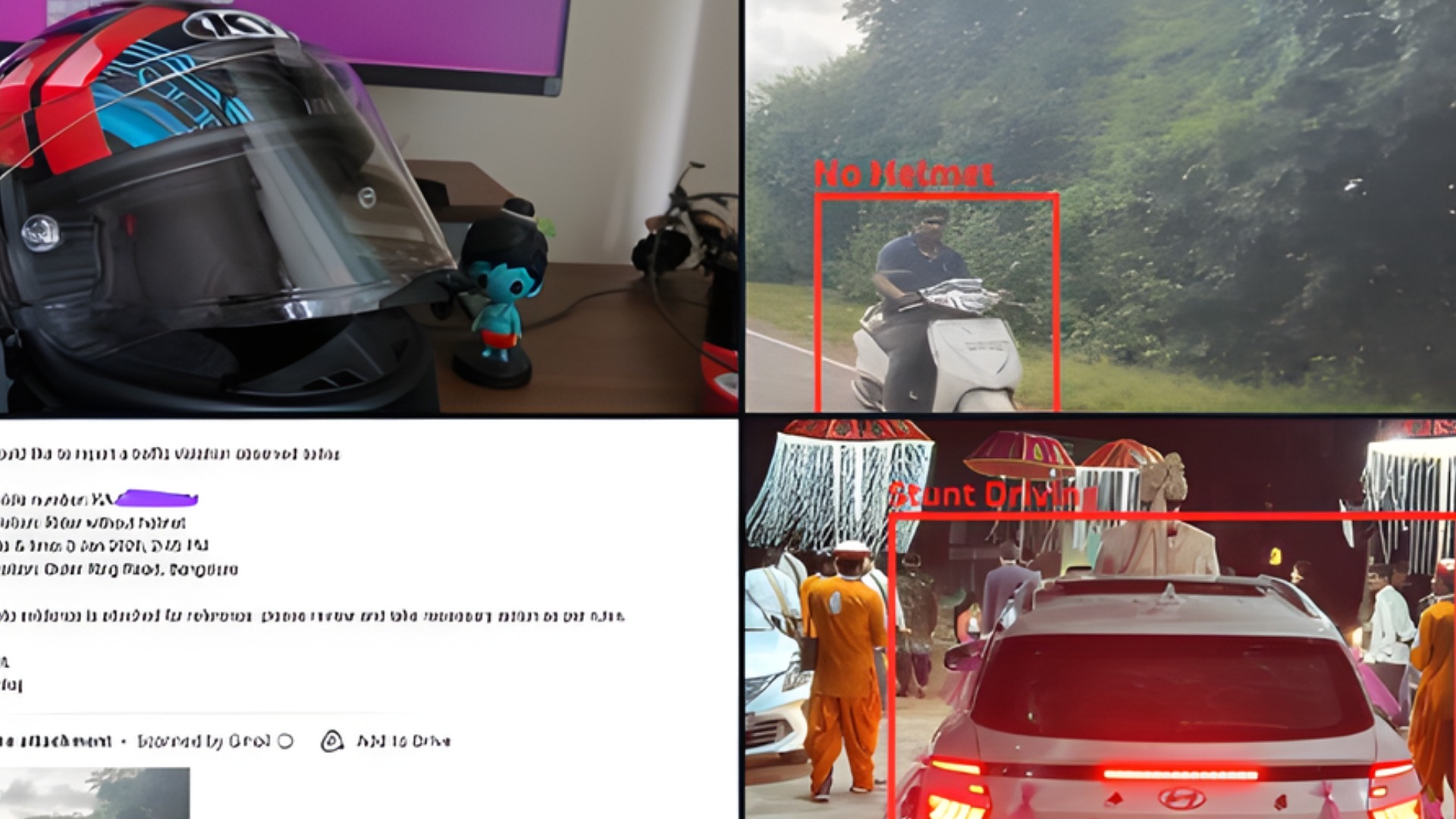
Pankaj Tanwar, who lives in the city’s Kadubeesanahalli area, has built a helmet-mounted, AI-powered system that detects traffic violations and automatically reports them to Bengaluru City Police in near real time. The do-it-yourself project, assembled using consumer hardware and off-the-shelf artificial intelligence models, has moved rapidly from a viral social media post to drawing the attention of senior police officials.
Tanwar said the idea grew out of routine frustration with riders jumping traffic signals, driving on the wrong side of the road, crossing medians, and riding without helmets. “Instead of confronting people on the road, I wanted to see if technology could do the reporting objectively,” he said. He shared a demonstration video on X in early January, captioned with a blunt remark about being “tired of stupid people on road.” The post quickly gained traction, with users calling it “peak Bengaluru innovation.”
How the AI Helmet Works
The prototype consists of a webcam mounted on Tanwar’s helmet and connected to a Raspberry Pi single-board computer. As he rides through the city, the system processes live video feeds on the device itself, using computer vision models to scan for four common violations: riding without a helmet, signal jumping, wrong-side driving, and divider crossing.
Unlike systems that rely on footage reviewed after the fact, Tanwar says his setup operates on the move. Each potential violation is tracked across multiple frames over roughly five seconds to reduce false positives. To further improve accuracy, he has layered multiple AI systems rather than depending on a single model. Outputs are cross-validated using large language and vision models, including OpenAI’s GPT and Google’s Gemini.
Only when the combined confidence score crosses about 96% does the system proceed to generate a report.
Automated Reporting to Police
Once a violation is confirmed, the software compiles an evidence package containing still images, short video clips, the vehicle’s number plate, a timestamp, and GPS coordinates. That bundle is automatically emailed to official traffic police addresses, using the same channels through which Bengaluru traffic police already accept citizen-reported violations via apps, email, and messaging platforms.
Tanwar does not manually review or send individual reports. “The idea was to remove human bias and effort,” he said, describing the process as largely autonomous once the system is running.
Built Cheap, Powered on the Go
The entire setup is built using readily available components. Tanwar estimates the prototype cost him only a few thousand rupees, largely from spare parts. Powered by a standard power bank, the helmet rig can operate for several hours, effectively turning the rider into a moving enforcement node rather than relying on fixed roadside cameras.
He believes the cost could drop further if the system were produced at scale, making it accessible beyond hobbyists.
Public Applause, Privacy Questions
Online reactions have been sharply divided. Many users praised the ingenuity, suggesting the idea be expanded using dashcams or even proposing incentives such as sharing a portion of challan fines with citizen reporters. Actor Kunal Kapoor called the project “brilliant.” Others suggested adapting the system to flag potholes or road hazards.
At the same time, critics raised concerns about privacy, constant surveillance, and the implications of civilians acting as always-on extensions of law enforcement. Some questioned how misuse, data retention, or selective reporting would be prevented if such systems became widespread.
Police Take Notice
The attention has extended beyond social media. Bengaluru City Police have contacted Tanwar following the viral posts. Joint Commissioner of Police (Traffic) Karthik Reddy said the department would review the system and engage with Tanwar to understand whether the technology could complement existing enforcement infrastructure.
The outreach signals institutional curiosity at a time when traffic police forces are stretched thin, even as cities expand faster than fixed-camera networks and patrol coverage.