



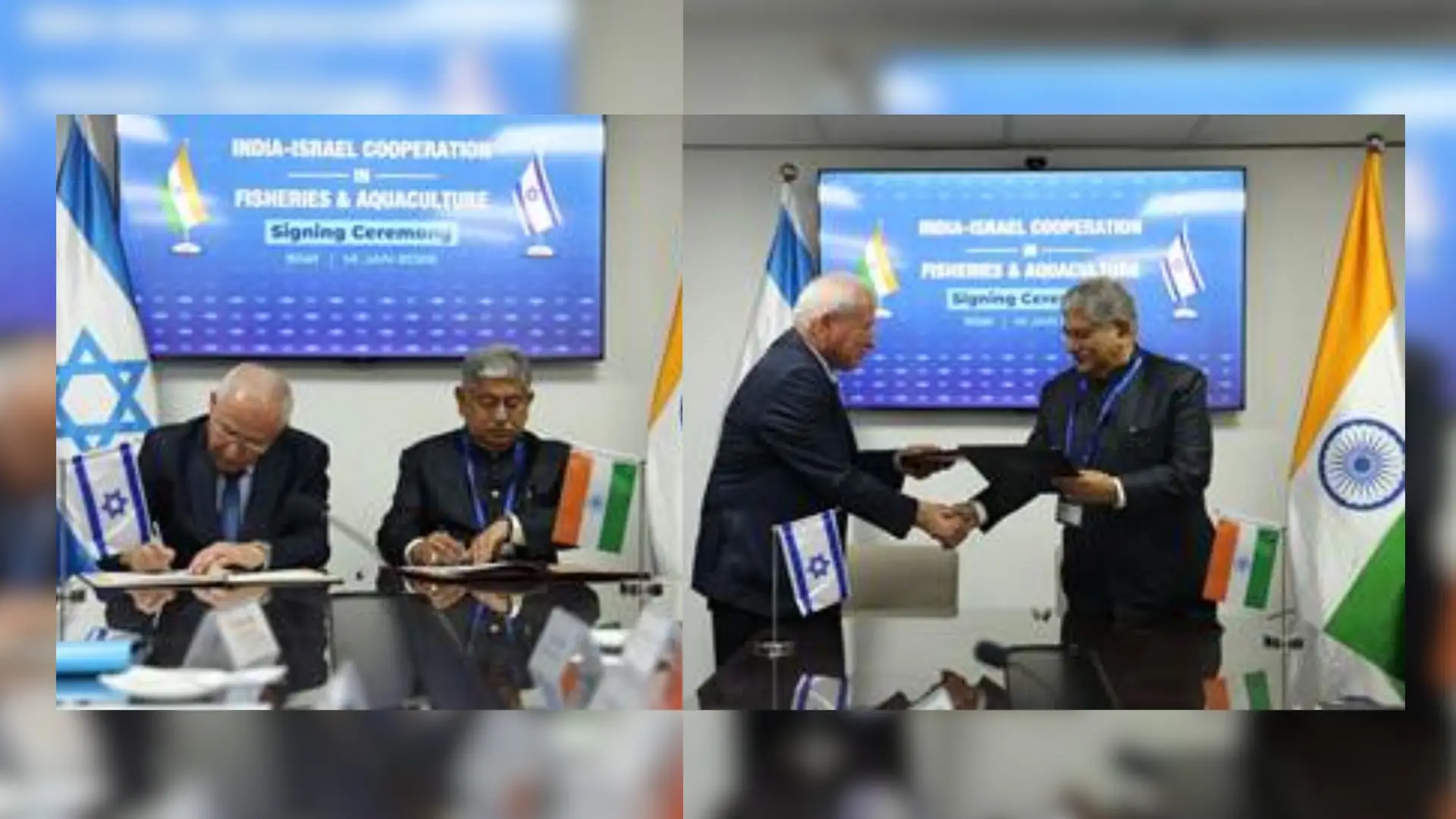
India and Israel have moved to deepen their strategic partnership in the blue economy, signing a Joint Ministerial Declaration of Intent to scale up cooperation in fisheries and aquaculture. The agreement was formalised on 14 January 2026, during a high-level Indian visit to Israel, and is positioned as a key pillar in both countries’ food security and climate-resilient growth strategies.
The Indian delegation was led by Union Minister of Fisheries, Animal Husbandry and Dairying; & Panchayati Raj Rajiv Ranjan Singh, who travelled to Eilat from 13–15 January 2026. The visit coincided with the Second Global Summit on “Blue Food Security: Sea the Future 2026”, where India’s participation underscored its intent to leverage international partnerships to modernise its fisheries and aquaculture sectors.
Building on a long standing and strategic partnership, New Delhi and Jerusalem framed the Declaration against their shared vision for sustainable development and recognition of fisheries and aquaculture as central to food security, livelihoods, and economic growth. Israel’s strengths in aquaculture and fisheries technologies, water management, and innovation are seen as complementary to India’s vast and diverse aquatic resources, creating a basis for a broad, technology-driven collaboration.
At the core of the Declaration is a comprehensive framework for joint work across advanced aquaculture systems. The two sides plan to cooperate on research and development in Recirculating Aquaculture Systems (RAS), biofloc, cage culture, aquaponics, and aquarium systems including oceanarium. The agreement also prioritises expertise sharing on breeding high-yield species, pathogen-free seed improvement strategies, and broodstock development, aiming to improve productivity and resilience across value chains.
Beyond production technologies, the partnership will extend to genetic improvement programs and mariculture, including seaweed cultivation, where Israel’s innovation in water-saving techniques could be applied to Indian coastal and inland operations. Water management in aquaculture, drawing on Israeli water-saving technologies, is identified as a critical area to boost efficiency while reducing environmental pressures. The Declaration also places particular emphasis on the exchange and support of start-ups in fisheries and aquaculture, using entrepreneurship as a vehicle to accelerate the Blue Economy.
Sustainability is woven through the agreement. Both countries commit to promoting sustainable and responsible fishing practices designed to conserve marine resources, curb ecological damage, and improve the long-term resilience of fish stocks. This includes collaboration on technology-based fisheries monitoring and data-collection systems that can underpin evidence-based management, enhance transparency, and improve traceability across supply chains, while remaining sensitive to the socio-economic needs of fishing communities.
Capacity building emerges as a major pillar of the cooperation architecture. The Declaration outlines initiatives in deep-sea fishing, vessel design and development, coastal aquaculture, and marine resource conservation driven by technology and innovation. India and Israel will explore exchange programs for fishers, aqua farmers, scientists, and policymakers, facilitating knowledge transfer and on-ground implementation. Training modules will extend to modern fish processing, marketing, and infrastructure development, including fishing harbours and fish landing centers, to ensure that upstream gains in production are matched by downstream efficiencies.
On the trade front, the Declaration aims to strengthen bilateral commerce in fisheries and aquaculture products. Dialogue mechanisms will be used to facilitate exports and imports and to address tariff and non-tariff barriers that currently limit flows. Both sides will support technology-driven traceability systems to meet global standards and consumer expectations, positioning their products more competitively in international markets.
A notable feature of the cooperation is the proposal to explore new Indo-Israel Centres of Excellence for Fisheries and Aquaculture. These would mirror the successful network of 43 agricultural Centres of Excellence already operational under the Indo-Israel collaboration, serving as hubs for applied research, demonstration, and capacity building tailored to aquatic systems.
Taken together, the Joint Ministerial Declaration represents a landmark step in India-Israel ties. By aligning innovation, sustainability, and trade, it opens new pathways for economic growth in fisheries and aquaculture while reinforcing both nations’ commitment to food security and climate-resilient development. The Eilat summit provided the backdrop; the real impact will be measured in how quickly joint projects, start-up collaborations, and Centres of Excellence translate this diplomatic framework into on-the-water outcomes.