



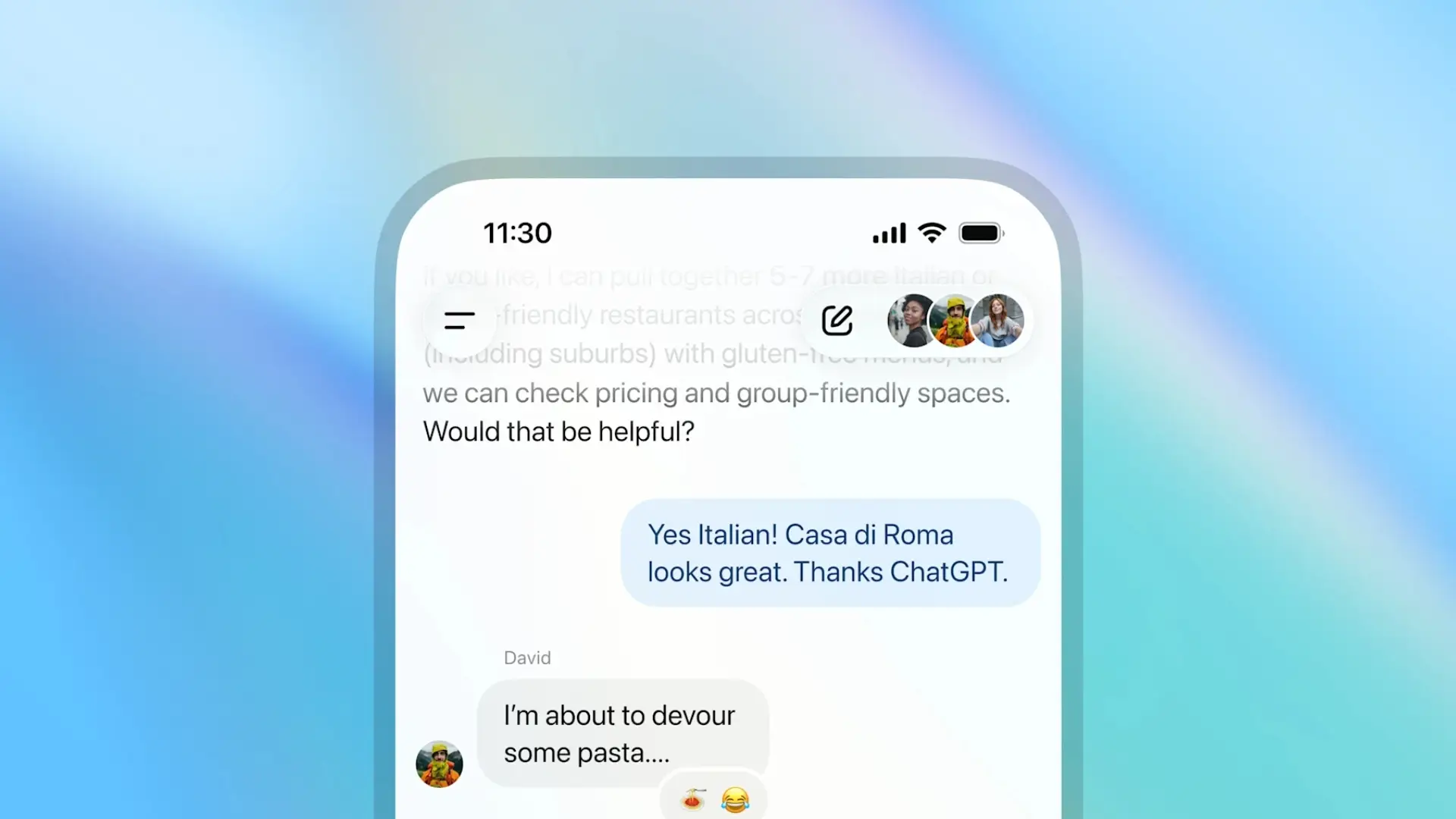
OpenAI has launched a pilot program for ChatGPT group chats in four Asia-Pacific countries: Japan, New Zealand, South Korea, and Taiwan. This new feature enables up to 20 participants to collaborate in a shared conversation with ChatGPT, marking OpenAI’s first step into social, shared AI experiences beyond individual interactions. The group chats function on both web and mobile platforms and are accessible to users on all ChatGPT subscription plans, including Free, Go, Plus, and Pro.
Users initiate group chats by duplicating existing conversations or starting new ones and invite others via shareable links. Participants create simple profiles with names, usernames, and photos. Group chats appear separately from personal chats within the interface. The AI operates on GPT-5.1 Auto, dynamically adjusting to each user’s subscription level, and interacts contextually by deciding when to respond or remain silent unless prompted by a direct mention of “ChatGPT.” Importantly, message exchanges among users are unlimited and do not count towards rate limits, which apply only to the AI’s responses.
OpenAI has implemented privacy safeguards to maintain separation between group and individual chats, with no shared ChatGPT memory across conversations. The platform automatically restricts sensitive content if a participant is under 18 and offers parental controls to disable group chats. This pilot aims to position OpenAI against existing messaging platforms by offering a collaborative, AI-assisted environment for planning, brainstorming, and decision-making. After feedback collection, OpenAI intends to expand the feature to more regions, signaling its broader vision of transforming ChatGPT into a shared communication and collaboration tool.