



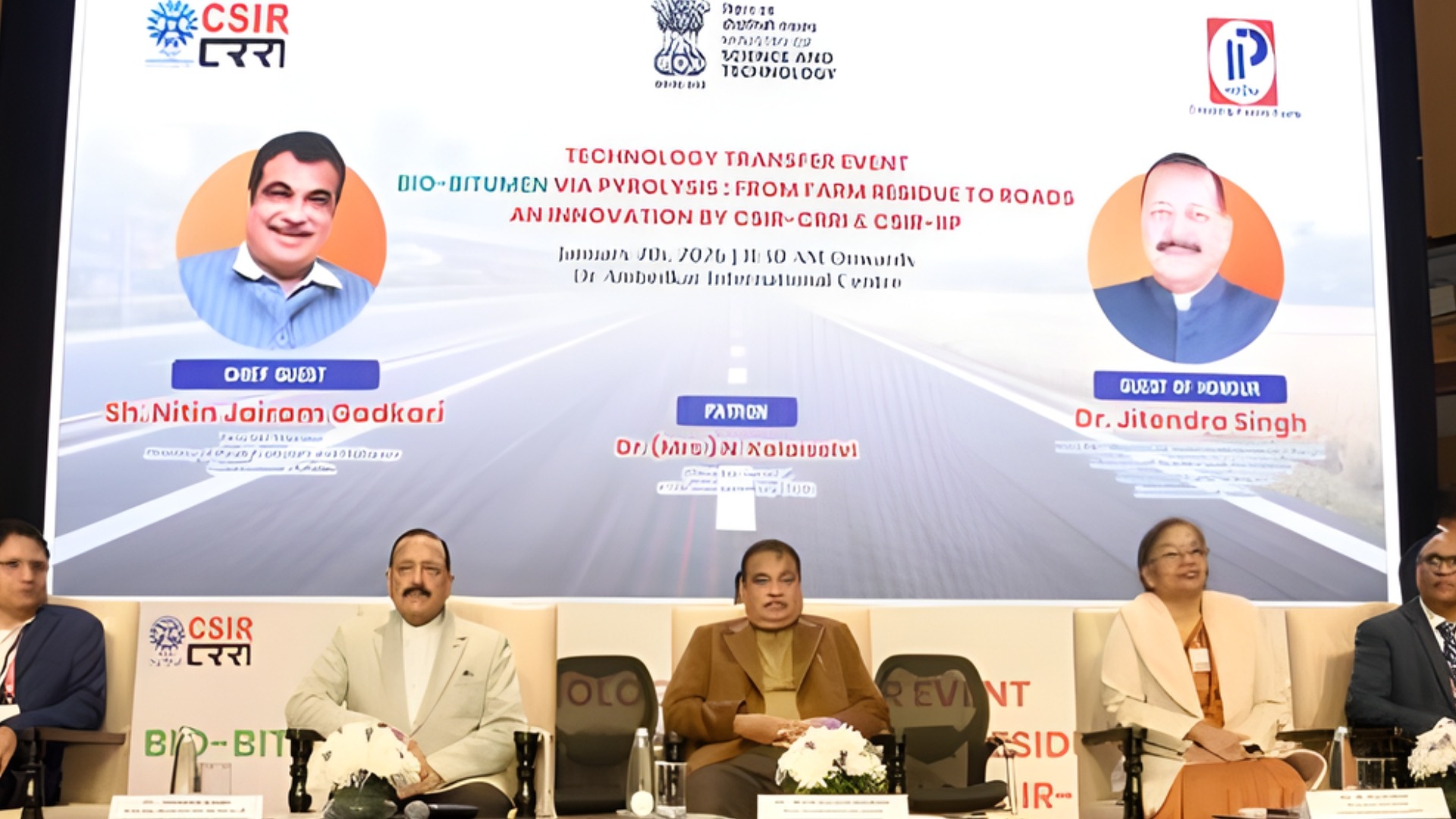
Union Minister Nitin Gadkari announced Wednesday that India has become the first country to commercially produce bio-bitumen, a petroleum-free road material made from agricultural waste. Speaking at a Council of Scientific and Industrial Research technology transfer event in New Delhi, he called it a “transformative step” toward the government’s Viksit Bharat 2047 vision for a developed nation.
The innovation, dubbed “From Farm Residue to Road: Bio-Bitumen via Pyrolysis,” stems from CSIR-Central Road Research Institute and Indian Institute of Petroleum. It converts rice straw, bamboo, and other crop residues into a blendable alternative that mixes up to 15% with conventional bitumen, slashing pollution from stubble burning and bolstering India’s circular economy.
A real-world test came with the Nagpur-Mansar Bypass on NH-44, inaugurated in December 2024 by Praj Industries and CSIR-CRRI. The material cuts greenhouse gas emissions by up to 70% compared to fossil-based bitumen.
On the economic front, 15% blending could save Rs 4,500 crore annually in foreign exchange, chipping away at India’s Rs 22 lakh crore fossil fuel import bill. With the country importing half of its 88 lakh tonnes of yearly bitumen needs, scaling this tech boosts energy security and rural jobs through waste sales to farmers.
Gadkari framed it as embodying Prime Minister Modi’s push for self-reliant, green growth positioning India to leap from the world’s fourth- to third-largest economy.