



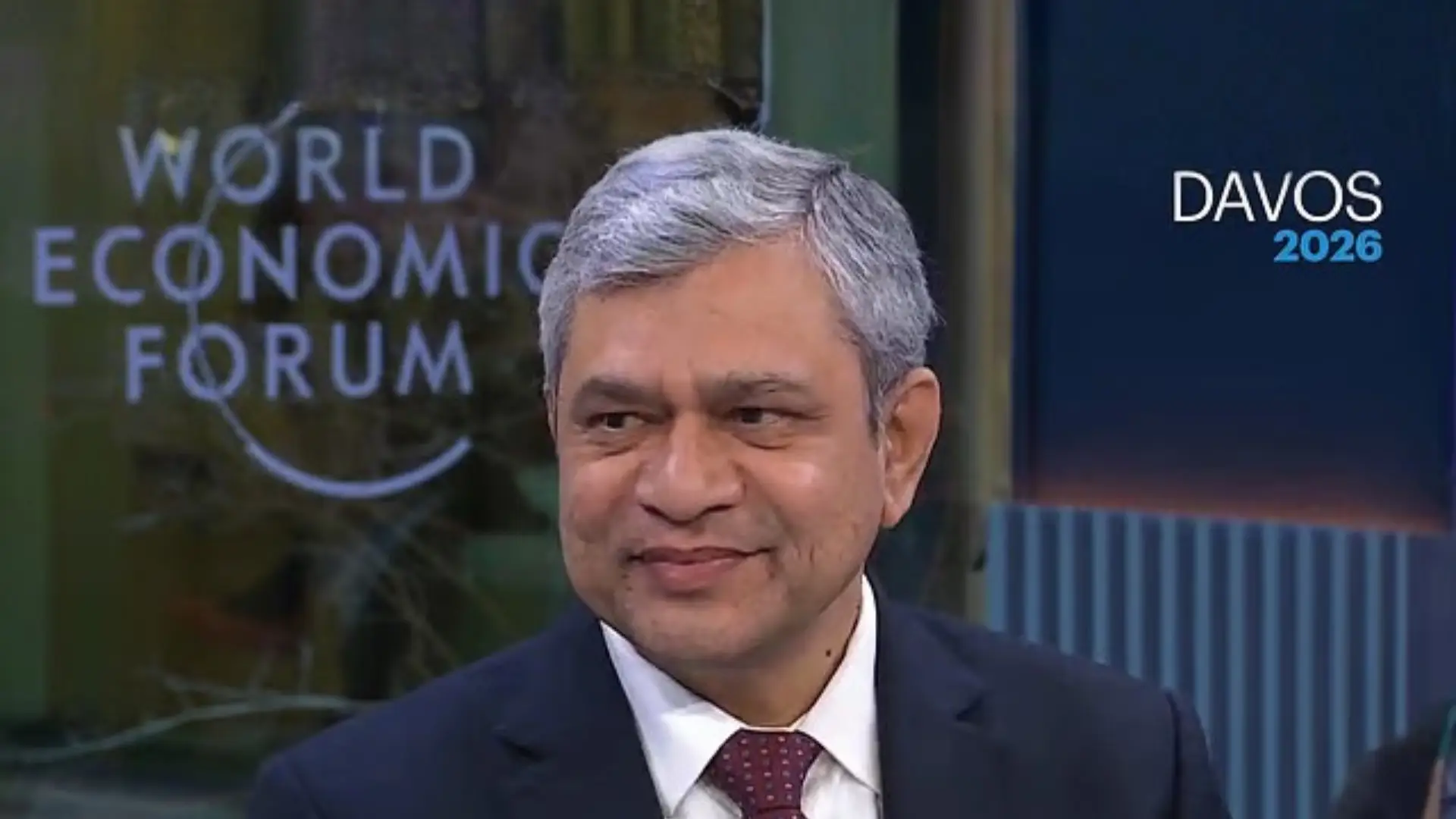
At the World Economic Forum in Davos, Union IT Minister Ashwini Vaishnaw pushed back against the International Monetary Fund’s recent assessment placing India in the “second tier” of artificial intelligence nations. Vaishnaw argued that India stands firmly among the world’s AI leaders, citing Stanford University’s 2025 Global AI Vibrancy Index, which ranks the country third globally in AI competitiveness behind only the United States and China.
“I don’t know what the IMF criteria has been, but Stanford places India as third in terms of AI penetration, preparedness, and talent,” Vaishnaw said, adding that on AI talent alone, India ranks second globally.
Outlining what he called India’s “five-layer AI strategy,” Vaishnaw highlighted progress across applications, models, chips, infrastructure, and energy. He emphasized that India is focusing on practical and scalable applications of AI, rather than competing in building massive large language models. “Ninety-five percent of the work can happen with models of 20 to 50 billion parameters,” he said, noting that India has developed a “bouquet of such models” deployed across multiple sectors.
Beyond AI, Vaishnaw said India’s stability, clear policy direction, and talent depth make it a “trusted partner” in a time of global uncertainty. The remarks come ahead of India hosting the AI Impact Summit in New Delhi on February 19-20, 2026 the first major global AI gathering in the Global South, focused on democratizing AI access and inclusive technology adoption.